


Cybersecurity used to be described mostly in technical language: firewalls, antivirus, passwords, patches, encryption, intrusion detection, and incident response. All of those things still matter. But modern organizations have learned, sometimes painfully, that cybersecurity is not only an IT problem. It is a business risk problem.
That is where cyber risk management comes in.
At its simplest, cyber risk management is the discipline of understanding what could go wrong in an organization’s digital environment, how much damage it could cause, what should be done to reduce or control that exposure, and how those risks should be monitored as the business and threat landscape evolve.
Different definitions in the literature emphasize different parts of this process. Some describe cyber risk management as the identification, prioritization, management, and monitoring of risks to information systems. Others define it as an ongoing cycle of identifying, analyzing, evaluating, and addressing cybersecurity threats. Taken together, these definitions point to the same essential idea: cyber risk management is not a one-time technical exercise, but a continuous business process for making informed decisions about digital risk.
But that definition is only the beginning. Cyber risk management is really about answering a leadership question:
How much cyber risk are we exposed to, how much are we willing to accept, and what are we doing about the gap?
That question is what separates mature cybersecurity from a collection of disconnected security tools.
Cybersecurity is not about eliminating risk
One of the most important ideas in cyber risk management is also one of the hardest to accept: you cannot eliminate cyber risk.
Every organization that uses technology accepts some level of exposure. Employees need email, cloud platforms, mobile devices, remote access, SaaS tools, payment systems, customer portals, APIs, and third-party services. Each of these creates value, but each also introduces risk.
A company could theoretically reduce cyber risk by disconnecting everything from the internet, banning suppliers, disabling remote work, and locking down every system. But that company would probably stop functioning.
So the goal is not “zero risk.” The goal is informed risk.
Cyber risk management helps leaders make conscious decisions instead of accidental ones. It gives the organization a structured way to decide which risks must be reduced immediately, which can be monitored, which can be transferred through insurance or contracts, and which may be accepted because the cost of reducing them is greater than the expected business impact.
That is why cyber risk management belongs inside broader enterprise risk management. Cybersecurity risk decisions should not live in isolation from business objectives, financial priorities, operational resilience, legal exposure, and customer trust.
What is cyber risk?
Cyber risk is the possibility that something involving technology, data, systems, people, or digital processes could harm the organization.
A practical definition is this:
Cyber risk is the possibility that a cyber threat will exploit a weakness and cause business impact.
That definition contains three important elements.
The first is threat. A threat is something that could cause harm. Examples include ransomware groups, malicious insiders, phishing campaigns, software supply-chain attacks, fraudsters, accidental data exposure, or even a cloud outage.
The second is vulnerability. A vulnerability is a weakness that could be exploited. It may be a missing patch, weak password policy, exposed API, misconfigured cloud storage bucket, poor backup strategy, excessive privileges, or lack of employee awareness.
The third is impact. Impact is the consequence for the organization. This may include financial loss, operational downtime, regulatory penalties, reputational damage, customer churn, legal liability, loss of intellectual property, or harm to safety and service delivery.
A threat without a vulnerability may not create meaningful risk. A vulnerability without a realistic threat may not be urgent. A threat and vulnerability with no serious business consequence may be a technical issue, but not necessarily a top business risk.
Cyber risk appears when these elements come together.
Why cyber risk management matters now
Cyber risk management has become essential because organizations are more digitally dependent than ever. Business operations, customer experience, finance, logistics, HR, legal, sales, and executive decision-making all depend on digital systems.
That means a cyber incident is rarely “just an IT incident.” It can become a business interruption, a legal matter, a regulatory issue, a board-level crisis, a customer trust problem, or a public relations emergency.
This is why cybersecurity leadership, cannot be reduced to technical expertise alone. A cyber leader needs to translate between technology and business: between vulnerabilities and operational exposure, between controls and strategy, between security teams and executives, between risk reduction and organizational value.
A strong cyber risk program gives that translation a common language.
Instead of saying:
“We have 8,000 vulnerabilities.”
A risk-based organization asks:
“Which of these vulnerabilities could materially affect our critical services, regulated data, revenue, safety, or reputation?”
Instead of saying:
“We need a new security tool.”
It asks:
“Which risk does this tool reduce, by how much, and is that reduction worth the investment?”
That shift is powerful. It changes cybersecurity from a cost center that constantly asks for more money into a management discipline that helps the organization make better decisions.
The cyber risk management lifecycle
Cyber risk management is not a one-time assessment. It is a continuous cycle. Threats change, systems change, suppliers change, regulations change, and business priorities change.
A practical lifecycle usually includes five major activities: identify, assess, prioritize, treat, and monitor.
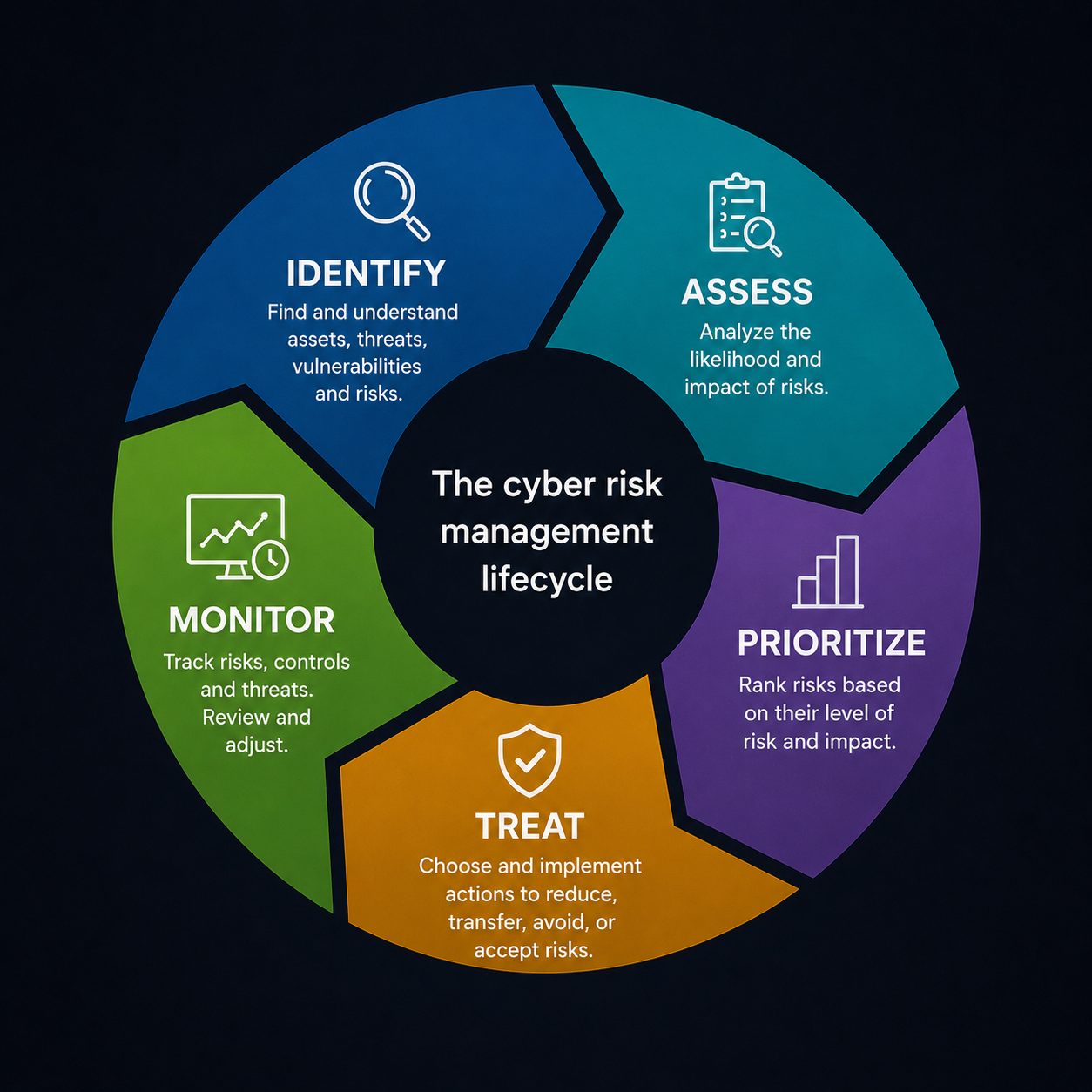
Identify: know what you are trying to protect
You cannot manage risk around assets you do not know exist.
The first step is to identify the organization’s important assets, systems, data, processes, users, third parties, and dependencies. This includes obvious assets like servers, laptops, databases, and applications, but also less visible ones such as cloud storage buckets, APIs, service accounts, shadow IT tools, SaaS platforms, privileged identities, and vendor integrations.
A good identification phase asks questions such as:
- What are our most critical business services?
- Where is our sensitive data stored?
- Which systems support revenue generation?
- Which applications are internet-facing?
- Which suppliers have access to our data or environment?
- Which identities have administrator privileges?
- Which systems would cause serious disruption if unavailable?
This is where many organizations discover that their cyber risk problem is partly an inventory problem. They cannot secure what they cannot see.
Assess: understand likelihood and impact
Once risks are identified, they need to be assessed. Assessment means estimating how likely a risk is to occur and how serious the impact would be if it did.
For example, imagine two vulnerabilities.
One affects a public-facing customer portal that processes personal data. It is actively exploited in the wild, easy to exploit, and present on a business-critical system.
The other affects an internal lab machine that is isolated, contains no sensitive data, and is scheduled for retirement.
Technically, both are vulnerabilities. From a risk perspective, they are not equal.
Assessment helps the organization distinguish noise from danger. It also helps avoid the trap of managing cybersecurity by raw volume: number of alerts, number of vulnerabilities, number of failed logins, number of tools deployed. Those numbers may be useful, but they do not automatically tell you what matters most.
A good risk assessment connects technical conditions to business outcomes. It asks: could this risk cause downtime, regulatory exposure, fraud, data loss, safety impact, customer harm, reputational damage, contractual penalties, or strategic disruption?
Prioritize: focus on what matters most
Cybersecurity teams almost always have more work than time. There are more vulnerabilities to patch, more alerts to review, more suppliers to assess, more policies to update, and more systems to harden than any team can handle at once.
Prioritization is therefore not optional. It is the heart of cyber risk management.
The organization needs to decide which risks require immediate action, which should be scheduled, which should be watched, and which can be accepted. Effective prioritization combines several signals: asset criticality, exploitability, exposure, threat activity, control strength, regulatory relevance, business impact, and risk appetite.
Risk appetite is especially important. It describes how much risk the organization is willing to accept in pursuit of its objectives. A hospital, bank, defense contractor, startup, university, and online retailer may all make different decisions because their missions, obligations, and tolerance for disruption differ.
Treat: decide what to do about the risk
After prioritization comes treatment. This is where the organization chooses a response.
There are four classic options.
The first is mitigation: reduce the likelihood or impact of the risk. This may involve patching systems, implementing multifactor authentication, improving backups, segmenting networks, training users, tightening access controls, deploying monitoring, encrypting data, or improving incident response.
The second is avoidance: stop doing the risky activity. For example, an organization may decide not to launch a feature that would expose sensitive data without adequate safeguards, or it may retire an outdated system rather than continue supporting it.
The third is transfer: shift part of the risk to another party. Cyber insurance, contractual requirements, indemnities, and outsourced services can transfer some financial or operational exposure. Transfer does not make the risk disappear, but it may reduce the organization’s direct burden.
The fourth is acceptance: consciously decide to live with the risk. This should not mean ignoring it. Proper risk acceptance is documented, time-bound, approved at the right level, and revisited when conditions change.
This is another point where leadership matters. Technical teams can recommend treatments, but business owners must often decide whether a risk is acceptable. Cyber risk management creates the governance structure for those decisions.
Monitor: keep watching because risk changes
Cyber risk is dynamic. A system that was low risk yesterday may become high risk tomorrow because a new exploit is released, a supplier is breached, a business process changes, a new regulation applies, or the organization moves data into a new environment.
Monitoring keeps the risk picture alive.
This includes tracking vulnerabilities, control performance, incidents, threat intelligence, third-party risk, compliance status, user behavior, cloud configuration, identity exposure, and key risk indicators. It also includes reviewing whether risk treatments actually worked.
This is where many organizations struggle. They perform assessments, create risk registers, assign owners, and then allow the information to become stale. A risk register that is not maintained becomes a historical artifact, not a management tool.
Cyber risk management should be treated as a living system.
How to calculate cyber risk
Cyber risk can be discussed qualitatively, using terms such as low, medium, high, or critical. But it can also be calculated in a structured way. The goal is not to create a perfect mathematical prediction. The goal is to create a consistent method for comparing risks, explaining decisions, and prioritizing action.
The most widely used basic formula is:
Risk = Likelihood × Impact
This formula is simple, memorable, and useful. It says that a risk becomes more serious when it is more likely to happen, when its impact would be larger, or both.
Formula 1: Risk = Likelihood × Impact
In this formula, likelihood means the probability or expected frequency of the event, while impact means the damage the event would cause.
A simple scoring model may use a scale from 1 to 5:
- 1 = Very low
- 2 = Low
- 3 = Medium
- 4 = High
- 5 = Very high
Using that scale:
Risk Score = Likelihood Score × Impact Score
Example: phishing attack against finance staff
Suppose a company has seen repeated phishing attempts against its finance team. Employees receive fake invoice emails every week, and one successful attack could lead to fraudulent payment.
The organization estimates:
Likelihood = 4 / 5
Impact = 5 / 5
Risk Score = 4 × 5 = 20
A score of 20 out of 25 suggests a high-priority risk. The company may decide to implement stronger email filtering, payment verification procedures, phishing-resistant multifactor authentication, and targeted awareness training for finance users.
The formula helps explain why the risk is serious: it is not only possible, it is both likely and potentially expensive.
Formula 2: Risk = Threat × Vulnerability × Impact
A slightly richer version of the formula separates the idea of likelihood into two parts: the presence of a threat and the weakness that could be exploited.
Risk = Threat × Vulnerability × Impact
This formula is useful because it reminds us that risk does not come only from attackers. Risk also comes from weaknesses in our own environment.
Example: exposed remote access service
Imagine a company has a remote desktop service exposed to the internet. Criminal groups commonly scan the internet for this type of exposure.
The organization estimates:
Threat = 5 / 5
Vulnerability = 4 / 5
Impact = 5 / 5
Risk Score = 5 × 4 × 5 = 100
This is a very high score. The threat level is high because attackers actively look for exposed remote access. The vulnerability score is high because the service is reachable and perhaps protected only by passwords. The impact is high because compromise could lead to ransomware or full network access.
This formula makes the treatment options clearer. The organization may not be able to reduce the global threat level, but it can reduce vulnerability by disabling public exposure, requiring VPN access, enforcing phishing-resistant multifactor authentication, limiting privileged access, and monitoring login attempts.
Formula 3: Residual Risk = Inherent Risk − Control Effectiveness
Before security controls are applied, a risk has an initial level. This is often called inherent risk. After controls are applied, the remaining risk is called residual risk.
A simple way to express this is:
Residual Risk = Inherent Risk − Control Effectiveness
This formula is usually used as a simplified scoring model rather than exact mathematics. It helps leaders understand that controls do not magically remove risk; they reduce it.
Example: ransomware risk before and after backup improvements
Suppose an organization estimates its ransomware risk as:
Likelihood = 4 / 5
Impact = 5 / 5
Inherent Risk = 4 × 5 = 20
The organization then improves backups, introduces endpoint detection and response, applies network segmentation, and tests restoration procedures. It estimates that these controls reduce the risk by 8 points.
Residual Risk = 20 − 8 = 12
The risk has not disappeared. A residual score of 12 may still require monitoring and further treatment. But the organization can now explain that the investment reduced the risk from 20 to 12, which is a much better management conversation than simply saying, “We bought a backup solution.”
Formula 4: Annualized Loss Expectancy = Single Loss Expectancy × Annual Rate of Occurrence
For financial risk analysis, organizations sometimes estimate expected annual loss. This is common in quantitative risk analysis.
The formula is:
Annualized Loss Expectancy (ALE) = Single Loss Expectancy (SLE) × Annual Rate of Occurrence (ARO)
Where:
Single Loss Expectancy (SLE) = Asset Value × Exposure Factor
Asset Value is the financial value of the asset, process, or system at risk. Exposure Factor is the percentage of value expected to be lost in one incident. Annual Rate of Occurrence is how often the incident is expected to happen per year.
Example: outage of an e-commerce platform
Suppose an e-commerce platform generates significant revenue and an outage is estimated to cost €200,000 per major incident, including lost sales, response costs, and customer support.
If the organization expects such an outage once every two years, the annual rate of occurrence is 0.5.
SLE = €200,000
ARO = 0.5
ALE = €200,000 × 0.5 = €100,000 per year
This means the organization can estimate the annualized risk exposure at €100,000.
Now suppose a resilience improvement project costs €40,000 and is expected to reduce the annualized loss expectancy from €100,000 to €30,000.
Risk Reduction = €100,000 − €30,000 = €70,000
Net Expected Benefit = €70,000 − €40,000 = €30,000
This gives the business a clear investment argument. The project is not just a technical upgrade; it is a risk reduction measure with a financial rationale.
Formula 5: Expected Loss = Probability × Financial Impact
A simpler financial formula is:
Expected Loss = Probability of Event × Financial Impact
This is useful when you want a quick financial estimate without building a full annualized model.
Example: business email compromise
Suppose a company estimates a 10% chance of a successful business email compromise attempt in the next year. If successful, the expected financial impact would be €300,000.
Probability = 10% = 0.10
Financial Impact = €300,000
Expected Loss = 0.10 × €300,000 = €30,000
The expected loss is €30,000.
If a control package costing €12,000 reduces the probability from 10% to 3%, the new expected loss becomes:
New Expected Loss = 0.03 × €300,000 = €9,000
Risk Reduction = €30,000 − €9,000 = €21,000
In simple terms, spending €12,000 to reduce expected loss by €21,000 may be a reasonable business decision, especially if the controls also reduce other related risks.
Formula 6: Risk Reduction = Risk Before Controls − Risk After Controls
This formula is useful when presenting the value of cybersecurity work to executives.
Risk Reduction = Risk Before Controls − Risk After Controls
Example: multifactor authentication for privileged accounts
Before introducing multifactor authentication, an organization scores privileged account compromise as:
Likelihood = 4 / 5
Impact = 5 / 5
Risk Before Controls = 4 × 5 = 20
After enforcing strong multifactor authentication and conditional access, the likelihood drops:
Likelihood = 2 / 5
Impact = 5 / 5
Risk After Controls = 2 × 5 = 10
Risk Reduction = 20 − 10 = 10
The impact remains high because a privileged account compromise would still be serious. But the likelihood has been reduced. This is important because some controls do not reduce the damage of an incident; they reduce the chance of the incident happening.
Formula 7: Risk Priority = Risk Score × Urgency
Sometimes two risks have the same likelihood and impact score, but one needs faster action. In those cases, urgency can be added as a prioritization factor.
Risk Priority = Risk Score × Urgency
Urgency may be based on active exploitation, regulatory deadline, public exposure, known threat activity, or business timing.
Example: two high-risk vulnerabilities
A company has two vulnerabilities, both with a risk score of 16.
The first vulnerability affects an internet-facing system and is being actively exploited in the wild. The urgency score is 5.
Risk Score = 16
Urgency = 5
Risk Priority = 16 × 5 = 80
The second vulnerability affects an internal system with no known exploitation. The urgency score is 2.
Risk Score = 16
Urgency = 2
Risk Priority = 16 × 2 = 32
Both risks matter, but the first should be handled first. This formula helps teams avoid treating equal base scores as equal operational priorities.
A practical risk matrix
Many organizations use a risk matrix to convert likelihood and impact into a simple visual priority. A basic version looks like this:
| Likelihood / Impact | 1 - Very Low | 2 - Low | 3 - Medium | 4 - High | 5 - Very High |
|---|---|---|---|---|---|
| 5 - Very High | 5 | 10 | 15 | 20 | 25 |
| 4 - High | 4 | 8 | 12 | 16 | 20 |
| 3 - Medium | 3 | 6 | 9 | 12 | 15 |
| 2 - Low | 2 | 4 | 6 | 8 | 10 |
| 1 - Very Low | 1 | 2 | 3 | 4 | 5 |
A simple interpretation could be:
- 1–5: Low risk
- 6–10: Moderate risk
- 11–15: High risk
- 16–25: Critical risk
The exact ranges should be adapted to the organization. A bank, hospital, or critical infrastructure operator may treat certain risks as critical even when a generic matrix would score them lower. The matrix is a decision-support tool, not a substitute for judgment.
Cyber risk management is not the same as compliance
Compliance matters. Regulations, standards, frameworks, audits, and contractual obligations all play an important role in cybersecurity. They create minimum expectations and help organizations prove that certain controls exist.
But compliance is not the same as risk management.
A company can pass an audit and still be exposed. It can have policies but weak execution. It can meet a control requirement but fail to protect the most critical business process. It can produce evidence for a compliance program while missing an emerging operational risk.
Compliance asks:
“Are we meeting the requirement?”
Risk management asks:
“Are we making the right decisions about uncertainty, exposure, and business impact?”
The best organizations connect the two. Compliance provides structure and accountability. Risk management provides context and judgment.
The role of people in cyber risk
Cyber risk is often described as a technology issue, but people are central to it.
People click phishing emails, approve payments, misconfigure cloud services, reuse passwords, delay patches, bypass procedures, and make architectural decisions. But people also detect anomalies, report incidents, design resilient systems, challenge bad assumptions, and make good risk decisions.
A mature cyber risk program does not treat people merely as the “weakest link.” That phrase is common, but it is not very useful. People are also the first line of detection, the owners of business processes, and the decision-makers who determine whether security is practical or ignored.
This is why awareness training alone is not enough. Organizations need security culture, clear accountability, executive sponsorship, usable processes, and collaboration between cybersecurity, IT, legal, finance, procurement, operations, HR, and business units.
Cyber risk management is a team sport.
The role of leadership
Cyber risk management needs leadership because risk decisions involve trade-offs.
Should the organization delay a product launch to fix a security issue? Should it invest in identity modernization or endpoint detection first? Should it accept a vendor with weak controls because the business urgently needs the service? Should it shut down a legacy system that still supports a profitable product? Should it pay for stronger resilience even if no incident has happened yet?
These are not purely technical questions. They involve strategy, finance, operations, reputation, customer trust, and sometimes ethics.
Good cybersecurity leadership makes risk visible, understandable, and actionable. It avoids fear-based communication and replaces it with clarity. It does not overwhelm executives with technical detail, but it also does not hide complexity behind vague red-yellow-green dashboards.
A useful cyber risk conversation tells leaders:
Here is the business asset at risk. Here is the threat scenario. Here is why it matters. Here is our current exposure. Here are the options. Here is the cost and benefit of each option. Here is the decision we need.
That is the language of management.
A simple example: ransomware risk
Consider ransomware.
A technical view might focus on malware detection, endpoint protection, backup tools, phishing filters, patching, and network segmentation. All of these are important.
A risk management view asks a broader set of questions.
Which business services would be most affected if systems were encrypted? How long could we operate manually? Are backups isolated and tested? Who has authority to declare a crisis? Which systems must be restored first? What legal, regulatory, and customer notification obligations would apply? Which suppliers would be involved? Would cyber insurance respond? How would we communicate with employees, customers, regulators, and the board?
The technical controls reduce the probability of ransomware succeeding. The business continuity and incident response planning reduce the impact. Governance determines who makes decisions under pressure. Monitoring helps detect early signs. Testing reveals whether the plan works.
That is cyber risk management in action.
Common mistakes organizations make
One common mistake is treating risk management as paperwork. The organization creates a risk register, assigns scores, and files it away. Nothing changes. No decisions are made. No investments are redirected. No accountability improves.
Another mistake is relying only on high, medium, and low labels. These can be useful, but they often hide the reasoning behind the score. A “high” risk should be supported by a clear scenario, affected asset, likelihood rationale, business impact, owner, treatment plan, and review date.
A third mistake is confusing tool deployment with risk reduction. Buying a security platform does not automatically reduce risk. It must be configured, integrated, monitored, maintained, and connected to processes.
A fourth mistake is failing to involve business owners. Cybersecurity teams may identify and analyze risks, but business leaders own many of the processes and decisions that create or reduce those risks.
A fifth mistake is ignoring third-party and supply-chain risk. Modern organizations depend on vendors, cloud providers, SaaS platforms, consultants, payment processors, managed service providers, and software libraries. The risk boundary is no longer the office network. It extends across the digital ecosystem.
What good cyber risk management looks like
A mature cyber risk management program feels different from a reactive security program.
It knows its critical assets. It has a current view of major cyber risks. It links technical findings to business impact. It has clear ownership. It uses metrics that inform decisions, not just metrics that are easy to count. It integrates with enterprise risk management. It reviews third-party exposure. It tests resilience. It learns from incidents. It communicates clearly with executives and the board.
Most importantly, it helps the organization choose.
Cyber risk management is not valuable because it produces reports. It is valuable because it improves decisions.
Should we invest? Should we delay? Should we accept? Should we escalate? Should we redesign? Should we stop? Should we monitor? Should we insure? Should we prepare?
Those decisions shape the organization’s real security posture.
Conclusion: from uncertainty to leadership
Cyber risk management is the discipline that allows an organization to move from uncertainty to informed action. It does not promise perfect security, and it should not pretend that every risk can be removed. Instead, it creates the structure, language, and evidence needed to understand exposure, make priorities visible, and choose the right response.
In a world where digital systems support almost every business process, cyber risk is business risk. A ransomware incident can interrupt operations. A data breach can damage trust. A supplier compromise can expose customers. A misconfigured cloud service can become a regulatory problem. A weak identity system can open the door to fraud, disruption, and reputational loss.
The organizations that manage cyber risk well are not necessarily the ones with the most tools or the largest security budgets. They are the ones that know what matters most, understand where they are exposed, measure risk in a consistent way, communicate clearly, and make decisions before a crisis forces them to.
That is the real value of cyber risk management. It turns cybersecurity from a reactive technical function into a strategic management capability. It gives executives, security teams, and business leaders a shared way to discuss difficult trade-offs. It helps investment follow risk. It helps controls serve business objectives. It helps the organization become not only more secure, but more resilient, more accountable, and better prepared for the digital threats that will continue to evolve.
Cyber risk will never disappear. But with the right approach, it can be understood, measured, reduced, monitored, and governed. And that is what mature cybersecurity leadership is ultimately about: not chasing the illusion of absolute protection, but building the capability to make sound decisions under uncertainty and protect the trust on which the organization depends.
References
- IBM Think. “What is cyber risk management?” https://www.ibm.com/think/topics/cyber-risk-management
- Hyperproof. “Cybersecurity Risk Management Process.” https://hyperproof.io/resource/cybersecurity-risk-management-process/
- Erdal Özkaya. Cybersecurity Leadership Demystified. Used as conceptual inspiration for the leadership-oriented framing of cybersecurity risk management.